They Are Selling You a Car With No Engine: Inside the Media's Most Dangerous Lie
We blame a single man because admitting the entire machine failed means admitting we have no idea how to put the pieces back together.

TAKE THE STAND · No. 1
No One Man Could Have Done This
Which is the part nobody wants to say out loud
Take the Stand is a new column. The political class produces a certain kinds of claims, delivered with confidence, rewarded with agreement, anchored to nothing a person could check, and never once followed by a question. That is the trick. This column is the questions that should be asked. I take the claims least tethered to reality, set them against the evidence, and write out what their makers should have to answer, and never do.
A failing system generates consolations on its way down, and this week it produced two. The first says we have survived worse. The second says one man broke this, so one man can mend it. Both were offered by serious people, in serious outlets, and both are false, and they are false in the same place, and that place is the one thing an American has to understand before the next election.
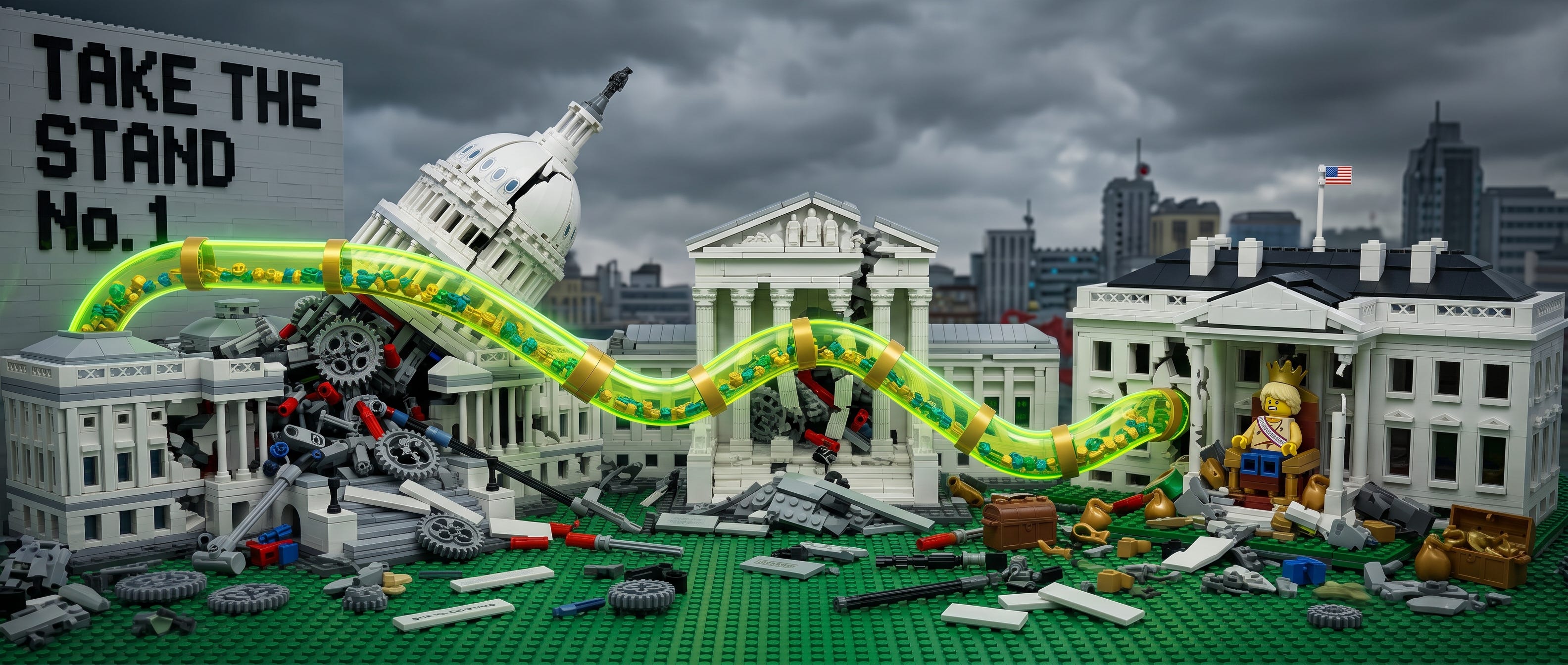
The men who drafted the Constitution were engineers before they were anything else. They did not trust virtue. They expected its absence. They assumed the demagogue would come, that some future officeholder would try to gather every lever into one fist, and they built the machine to survive him anyway. They built it the way you build any system that is not allowed to fail. They built in redundancy. Three branches, each able to halt the others. Two legislative chambers instead of one. Impeachment. Judicial review. Elections on staggered clocks. Every piece of it serves a single specification, written plainly into Federalist 51 and every argument since. No one man could be permitted to bring it down. Not a wish. A requirement.
Both of this week’s consolations violate that requirement, and from opposite ends.
Exhibit A: “We have survived worse”
No one signs this one, because everyone reaches for it, and it always arrives carrying the same evidence. We survived the Alien and Sedition Acts. We survived a civil war. We survived McCarthy. We survived Watergate. The country has stood on worse ground and is standing yet, the argument goes, so lower your voice and steady your hands. Every example is true. Every one of them proves the reverse of what it is offered to prove, because the thing worth noticing was never the crisis. It was what ended the crisis. McCarthy did not fall to the passage of time. A functioning Senate condemned him by resolution in 1954, on the record, by name. Nixon was not carried off by history. A Court that counted his own appointees ruled against him without a single dissent, a Congress in which his own party had turned stood ready to impeach him, and he resigned rather than meet them. The republic outlived those men because the machinery built to outlive them worked. It fired. That is the one thing it is not doing now.
Perhaps it is the numbers they mean, not the history. The numbers only look kind. V-Dem scores American liberal democracy at 0.57 for 2025, roughly the same reading it held in the mid-1960s, and there is the trick, because a figure set beside the country’s own past invites you to exhale. You do not judge an aircraft you're about to board by how aircraft flew sixty years ago. You judge it against the traffic in the sky right now. That mid-1960s reading sat in a thin field, a world still mostly colonial, communist, or run by colonels, with a short roster of genuine democracies. The identical reading today sits in a world that spent the intervening half-century filling with them, the entire third wave, dozens of republics clearing a bar the United States helped set. V-Dem now ranks the country 51st of 179. Fifty nations rate higher. The score still clears the global average of 0.377, and that is precisely the tell. Against the planet’s floor, America passes. Against the democracies it actually belongs among, it is losing altitude. The floor never moved. The ground rose while the country stood still, and in a climb, standing still is descent.
The ranking fixes where the country sits. The velocity is what the reassurance cannot survive. V-Dem records the American score falling 24 percent in one year, the sharpest fall it assigns to any established democracy, a collapse its lead author, Staffan Lindberg, calls unprecedented in modern history. The Century Foundation’s new Democracy Meter runs the same event through different instruments and lands in the same place, 79 out of 100 in 2024, 57 in 2025, a 28-percent drop of a kind its authors say is normally seen only after a coup. Freedom House, which kept the country inside its “free” tier, still logged the largest one-year decline of any established free democracy on earth. Bright Line Watch, polling hundreds of political scientists, now rates the system nearer a mixed or illiberal regime than a full democracy. Four instruments, four methods, one reading.
Unprecedented is a word worn smooth from overuse, so take it literally here, because for once it is not decoration. It means three things that have never been true together. The country could fall this far only because it had lately climbed high enough to have the distance to fall, an altitude it did not hold in 1860 or in 1954, when it sat low and simply stayed there. A drop this steep is the fingerprint of a coup, and this one came without a successful one, run through the courts and the confirmations and the ballot rather than around them, the machinery itself turned against the thing it was built to guard. In every earlier emergency at least one branch held and caught the country as it dropped, where this is the first time all three have let go at once. That is why we have not been here before. Not because the country was never in danger. Because the danger always met something still standing. This time it met nothing.
So yes, we have survived worse, and every time, the surviving was done by the safeguards. That is the entire answer to the reassurance. The thing that produced every recovery it points to is the redundancy, and the redundancy is the thing that has failed.
Exhibit B: “One man broke it, so one man can fix it”
This is the second consolation, and it is the more refined of the two, which makes it the more dangerous.
Speaking this week about the country’s 250th year, Susan Glasser of The New Yorker admitted she has a “hard time making the case to a young person.” She wanted them to hear, though, that “giving in isn’t the answer,” that “if somebody can change the meaning of that history so radically as Trump has done, then also somebody can change it back.”
She means it kindly, and that is the trouble, because kindness is how this particular error travels. Glasser has the physics backwards, and she has it backwards the way most of her profession does. We made our peace long ago with a public that cannot parse a study or read a chart, a scientifically illiterate country, a media-illiterate one. What this week exposes is that the people whose entire vocation is to explain the government to that public do not understand the government either. When a veteran political correspondent describes the dismantling of a constitutional republic as a thing one man did, she is confessing that she never absorbed the first lesson the republic teaches, the separation of powers, the checks and balances, the reason the office she covers cannot, by design, act alone. That is civic illiteracy, and it is wearing a byline.
A president standing by himself can do almost nothing that lasts. He cannot pass a law. He cannot spend a dollar the Congress has not appropriated. He cannot seat a judge, a secretary, or a general without a Senate that agrees to it. He cannot edit a comma of the Constitution. Alone, the office can sign orders and watch the courts enjoin them, and that is very nearly the whole of its solitary power. Everything durable this administration has done required a Congress to fund it, a Senate to confirm the people who carried it out, and a Court to declare it lawful. So when you are told one man did this, hear what the sentence is built to hide. It hides the appropriations. It hides the confirmations. It hides the rulings. It hides the most damning fact in the entire account, that the man at the center of it is no strategist and no mastermind but a plainly, extravagantly incompetent one, which means the wreckage is not the measure of his power. It is the measure of how many people who hold real power decided to hand a country to a fool and step back.
That is what the framers did not foresee, and the only thing that could have defeated their design. Not a strong president. A president is a single component, and single components were the whole problem they solved. What defeats redundancy is correlated failure, every independent safeguard going dark in the same event because one defect runs through all of them. That is what the instruments record. Not a powerful executive. Absent guardrails.
The steepest declines V-Dem records are not at the presidency. They are in the liberal component, the legislative and judicial constraints on executive power, which the report places at their lowest in more than a century. The Century Foundation’s largest collapse is the category it calls State Institutions, 22 out of 30 down to 10, and its explanation is flat. Congress and the judiciary failed to check an executive that disregarded court orders and engaged in grand corruption. The gauges are not describing a man. They are describing the offices built to stop him, reading empty.
The evidence has names and dates, and it is not composite. In Trump v. Anderson the Supreme Court ruled that states could not strike from the ballot a man who had tried to overturn an election. In Trump v. United States the same Court handed him immunity for official acts, which Freedom House describes, in its own dry register, as gutting a central deterrent against wrongdoing by the country’s most powerful person. He pardoned the people who stormed the Capitol in his name. His own federal prosecutions were folded up and wheeled away. Congress impeached him twice and removed him never. Each of these was a backup system. Each was handed its moment to arrest the fall. Each stood down.
When every independent system fails in one event, investigators do not write it up as misfortune. They hunt the common cause, the single defect that defeats the independence the whole design depended on. American government has one. It has a shape and it has a name, and once you see it you cannot stop seeing it. Call it the corruption membrane.
A membrane is not a wall. A wall stops everything. A membrane chooses. It is a living barrier that reads what arrives and decides what may pass, and this one runs not between the branches but through all three of them at once, a shared tissue of incentive that turns the separation of powers into a costume. What crosses it freely is money, which prices the campaigns that seat the legislators, funds the presidents who name the judges, and reaches the judges themselves as hospitality and gifts. What crosses it freely is party, the one organism spanning the House, the Senate, the executive, and the confirmed bench, so that a senator’s loyalty runs to his party and not to his chamber, and the instant his party holds the presidency his institutional check dissolves on contact. What crosses it freely is compliance, the sole currency of advancement, the thing you pay to chair a committee, to keep a nomination breathing, to be seated anywhere near power.
What the membrane stops, reliably and selectively, is everything that would repair the system. It stops independence, the member who arrives meaning to check her own side and is held at the perimeter, denied the gavel, buried in a primary, starved of money. It stops reform, the bill that dies in the committee it was routed to, the nominee who never reaches a vote. It stops accountability, the impeachment that does not remove, the prosecution that does not land, the disqualification that does not stick. The membrane admits the solvent and blocks the repair. That is its entire function.
Redundancy is only redundancy when the channels are independent. Three backups wired to one power supply are not three backups. They are one, and it has failed. The corruption membrane is that shared supply. It is why Congress, the Court, and the presidency, three systems the framers insulated from each other with enormous care, now fail in the same direction at the same time. They were never independent. They only looked independent from the outside, before the membrane was visible.
The man’s name hides the rest. The membrane predates him. It priced the campaigns and confirmed the justices and starved the reformers for decades before he descended the escalator. He did not build it. He is what a finished membrane produces, a president who commits an impeachable act on a Tuesday and is not gone by Thursday, not because he is strong but because every office that could remove him sits on the far side of a barrier he never has to cross. He is not the breach in the membrane. He is its reflection, wearing a sash.
The cross-examination
Put the two consolations on the stand. Not the people who spoke them, the claims themselves. Ask the questions a ninth grader could ask, the ones that end with the speaker conceding the thing they came to deny. In order, out loud.
If the safeguards are what saved us before, and the safeguards are what failed this time, on what exactly does the rescue depend?
If a president cannot pass a single law alone, how did one man break the government, and how is one man going to fix it?
Last question, for both claims at once. Is what you are selling a reading of the Constitution, or a way to avoid naming everyone in it who is guilty?
The verdict
Glasser’s hope is not merely sunny. It rests on a false premise, the same one holding up the reassurance it answers. If one man had done this, one man could undo it, but one man could not do it, which is the whole finding, and it points where no one with a microphone wants to point. It points at the Senate that would not remove him. It points at a Court that kept him on the ballot, immunized his crimes, and let his mob walk. They did this. They took the most incompetent man ever to reach the office and handed him a republic.
Understand what her hope would have to overcome. In 2008 hope was a rational bet, because the machine still ran. The country was a used car with two hundred thousand miles on it, the radio dead, the alignment pulling left, but it turned over every morning and it moved, and if you caught the right pothole the radio would flicker back for a block. You could hope, because there was a working thing to hope about. It is not 2008. The car has been pulled apart in the driveway by a toddler who wanted to see the pieces, the engine on the lawn, the wheels against the fence, the bolts scattered where the rain can reach them, and no amount of hoping turns that key. That is the first hard thing. The second is worse. Action will not do it either, not alone, because a heap of parts does not become a car in the hands of someone who has never built one. You can arrange the pieces for the rest of your life, sort them, hope over them, and nothing will start, because putting a machine back together requires knowing how the machine was made. The public has shown us, in its scientific illiteracy and its civic illiteracy, that it does not know how. The people paid to explain the machine have shown us, this week, that they do not know either. So when you are offered hope, see it for what it is. Not a plan. Not a blueprint. A feeling, held over a pile of parts, by people who cannot name what the parts are for.
This is why the repair story is misdirection and not optimism, aimed at the ballot and the bench and the floor of the House, the very institutions already taken, promising rescue from the captured thing. The United States is not the country in the story. It ranks fifty-first, it jails more human beings than any nation alive, and it watched every safeguard it owns stand down inside a single year while the people paid to notice called it the work of one man. The framers built a system no one man could destroy. They did not build one that could survive its own guardians, and they did not build one that a country could put back together once it had forgotten how the thing was made. The instruments have been screaming that for a years and the people paid to read them keep calling for us to hope.
They made a take. We’ll put them on the stand.
If You Are Still Here...
There is no comfort to be found in the unvarnished ledger of this country’s decline. If this text made you uncomfortable, it did its job.
This publication operates on a single premise: that comfort is an indulgence we can no longer afford. If you refuse the soft distractions of a self-soothing media class, please share this piece on Notes or with someone who still believes the machine can be restarted. Your subscriptions and shares are the only currency keeping this signal alive. Thank you for refusing to blink.
Been telling folks for years, if you don’t know how a thing works you can’t make it work for you.
Citizenship for example must be taught. As I understand it, Civics classes have been cut in order to (cue the magic word) SAVE money! It’s all about SAVING money, right?
This maladministration has destroyed our country in a literal sense.
PS: Restacked with a venegence!
The single most depressing thing I have ever read.
Thank you for writing it.