The Easiest Way to Make Yourself Impossible to Fool.
A break from the wreckage, and an invitation to run a machine with your own hands.

You Cannot Buy This. That Is the Point.
I am taking a break.
For nearly a hundred essays I have written about the wreckage, the men who caused it, the institutions that absorbed it, and the citizens who learned to live inside it. You can only describe a collapse from so many angles before the angles start to repeat, and something happened after my last piece that makes this a natural place to pause the work for a moment. For the first time, in real numbers, readers wrote to tell me the argument had landed. Not that it was provocative, not that it was well constructed, but that it was true, that leaving is a legitimate answer to the question this country keeps asking. I have been making that case for a long time (my best argument for why its the only solution still lives here). I am going to let it stand on its own for a while rather than pile another essay on top of it.
Every con depends on the same thing. Not greed, not gullibility, but a gap in understanding the mark cannot see across. The street dealer working three-card monte does not beat you because you are slow, he beats you because you do not know where the card is, and the entire craft is keeping you from finding out. Hold that image and widen it, because it is also a fairly complete description of how most of us are now governed.
A population that cannot explain its own institutions cannot audit them, cannot defend itself against them, and cannot tell the difference between a machine that is broken and a machine that is running exactly as designed against its interests. The helplessness is not a side effect of these systems. It is one of the things they manufacture.
Here is the counterweight, smaller and more stubborn than it sounds. Every system you understand firsthand is a system that can no longer be explained to you dishonestly. Once you have watched a mechanism turn over with your own hands, the salesman loses his best instrument, which was your ignorance, and in that one narrow domain you become unconnable. Nobody can tell you the card is somewhere it is not, because you saw where it went.
This essay is about making you unconnable in exactly one domain. By the end you will know what a ledger is, what mining buys, what decentralization costs, and what its absence smells like, not because I told you, but because you ran the real thing on your own hardware and watched it work.
So consider this a small celebration, and a return to the thing I loved before the news cycle conscripted me. Learning for the sake of learning. It is a pastime from an era when humanity was not facing an existential crisis on a rotating schedule, and I miss it, and maybe you miss it too. There are no villains in this essay. No exhibits entered against anyone, no indictments, no doom. Today I just want to show you a machine.
The machine nobody has watched run
Here is the thesis, stated up front so you can hold me to it. Cryptocurrency is one of the genuinely interesting machines our species has built, and almost nobody who owns it has ever seen it run, understands what it is, or cares about it function. I know what you are probably thinking right now, this guy is a crypto guy? I’m not a crypto guy, and I’m not trying to make you one. I’m just writing about a technology that is interesting, and I think it you keep reading you’ll start to see why. (Hint its not about making money)
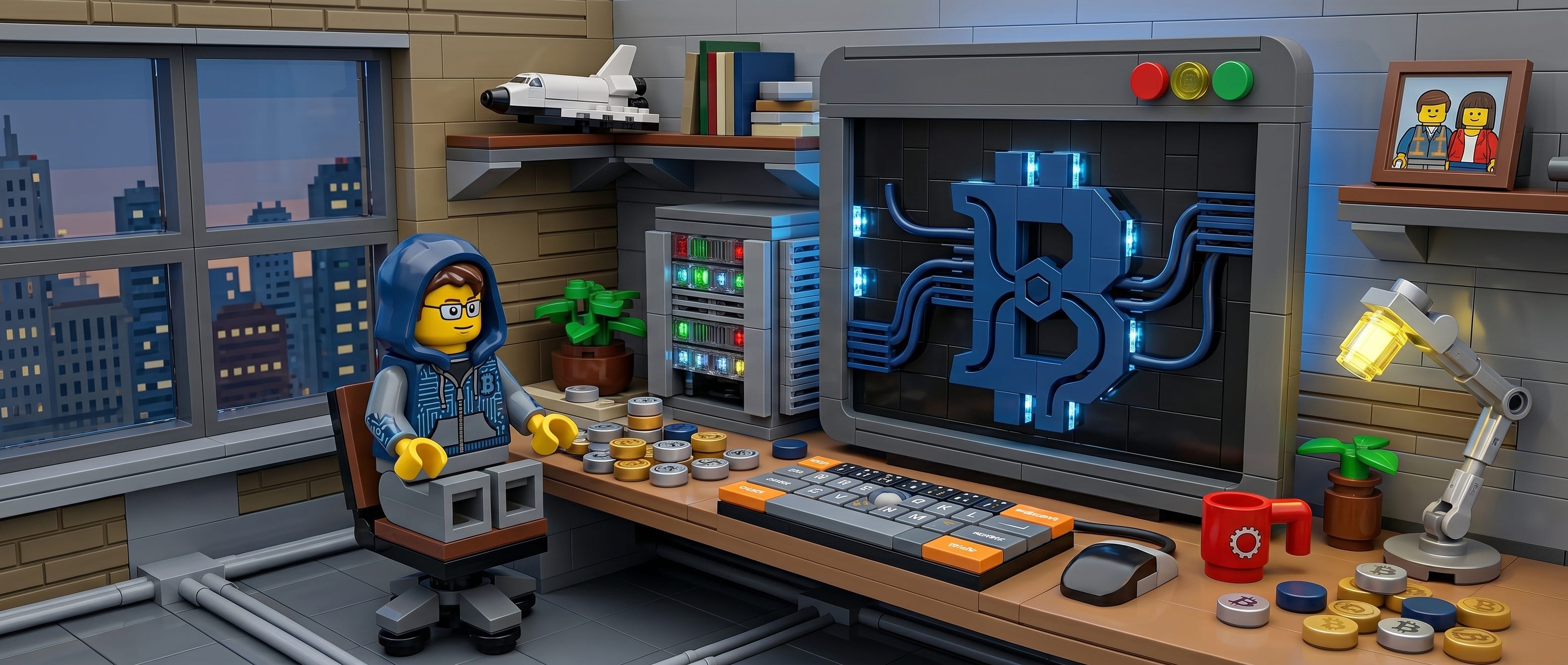
The underlying achievement is easy to state and hard to overstate. A network of strangers, scattered across the planet, none of whom trust each other and none of whom are in charge, can agree on the contents of a shared record using nothing but mathematics and electricity. No bank in the middle. No government seal. No referee. That is a real thing, it exists, it works, and when it first worked in 2009 it solved a problem computer scientists had circled for decades.
Then, somewhere between 2009 and now, the financial industry welded the hood shut. The technology disappeared inside its own price. “Crypto” stopped meaning the engineering and started meaning the chart, a number that goes up or down, an asset people hold the way they hold a lottery ticket. Ask ten crypto owners what actually happens when a transaction confirms and nine will not know, which is a strange relationship to have with your own property, like owning a car you are not allowed to start.
The goal of this essay is to pry the weld open.
First, the unusual conditions
Before we touch anything, the facts that make this essay possible, because they are rare and they are the entire reason I am writing it.
I have no affiliation with the project I am about to describe. I will make no money if you read this, no money if you participate, no money ever, and neither will anyone else, because there is no money in the system at all. The project is called BrowserCoin. It has no exchange. It has no price. There is no way to hand someone a dollar and receive a coin, and no way to hand someone a coin and receive a dollar. There was no presale, there is no founder allocation, no team tokens parked in a wallet waiting for an exit. Every coin that exists, exists because somebody’s computer made it, and it isn’t going to make you rich.
I want to be as clear as I can be about why this matters. Nearly every piece of writing about cryptocurrency you have ever encountered was produced inside a conflict of interest, because the writer, the platform, the project, or the advertiser stood to gain if you bought in. This one was not, because there is nothing to buy in to. The absence of a market is not a disclaimer I am obligated to mumble before the real pitch. There is no pitch, there is no money; there is only the opportunity to learn.
What the machine actually does
Strip away the charts and a cryptocurrency is a ledger, which is just a list of who owns what. Your bank keeps one. Every entry in your account is a line in a list that the bank maintains, and when you pay someone, the bank edits the list. The hard problem was never keeping the list. Institutions have kept lists for centuries. The hard problem is deciding who gets to keep it, because whoever holds the pen can edit history, freeze an entry, or quietly add a zero.
Bitcoin’s answer in 2009 was strange and elegant. Nobody keeps the list, and therefore everybody does. Every participant holds a complete copy, and new pages are added through an open contest. To write the next page of transactions, your computer must win a lottery in which the tickets are computational guesses, billions of them, each one a tiny math problem with a randomized answer. Find a guess whose answer falls below a moving target and you have proven, mathematically, that you burned real electricity to get there. The network accepts your page, everyone’s copy updates, and you collect a reward of newly created coins for your trouble. This contest is called mining, the proof of burned effort is called proof of work, and it is what makes the history expensive to forge. Rewriting last week means redoing last week’s electricity, plus everything since, faster than the entire honest network combined.
That is the whole trick. Strangers agree because lying costs more than telling the truth.
How the hood got welded
Two welds, applied in sequence. The first was speculation. Once coins acquired dollar prices, the chart consumed everything, and an instrument for distributed consensus became a vehicle for getting rich, which attracted exactly the people you would expect. The second weld was quieter and worse. New coins launched by the thousands that abandoned the core idea entirely, networks controlled by a foundation, by a small council of insiders holding shared override keys, by governance structures nobody can actually vote against. These projects kept the vocabulary and discarded the substance. A coin with a central authority is not a refinement of the interesting thing. It is the abandonment of it, a bank rebuilt with extra steps and worse customer service, because the entire point of the machine is that no one is in charge.
So the genuinely novel technology of the century got buried twice, once under money and once under fraud wearing its uniform.
The engine on the workbench
BrowserCoin is what happens when someone unbolts the engine from all of that and sets it where you can examine it. It is an open source project, MIT licensed, the full code public on GitHub and small enough to actually read. The premise is participation stripped of every barrier. Open a webpage and you are in. No login, no signup, no email, no identity, because the original design never required one. Your browser becomes a full participant in a peer-to-peer network, talking directly to other browsers, mining blocks, verifying transactions.
The historical rhyme is deliberate. Bitcoin in 2009 was a handful of people running a program on personal computers, finding blocks, collecting fifty coins apiece that nobody had paid for and nobody could sell. There was no chart because there was nothing to chart. They were there because the experiment was interesting. That moment closed for Bitcoin years ago, sealed off by warehouses of specialized hardware. It is not closed here. Participating in Bitcoin in 2009 was hard. This is not.
What I want to do with the rest of this essay is walk the bench, component by component, because none of the engineering choices are arbitrary and each one teaches you something true about how these systems survive in the wild.
The fuel. When you mine BrowserCoin, every single guess your computer makes requires filling 32 megabytes of memory, using an algorithm called Argon2id. This sounds like a detail. It is the project’s most political decision. Bitcoin mining was supposed to be done by ordinary people on ordinary computers, and today it is done by industrial facilities full of single-purpose chips that outperform your laptop by a factor of millions, which means ordinary participation is extinct. A memory-hard puzzle resists that consolidation, because specialized chips have enormous computing power but no comparable advantage in memory bandwidth, and memory bandwidth is the bottleneck here. The gap between a twenty-thousand-dollar server and a four-hundred-dollar laptop stays small enough that everyone retains a real chance of finding blocks. The cost of egalitarian mining is that your fan spins. That is the whole cost.
The gearing. The monetary rules are lifted from Bitcoin with intent. A total supply of 21,000,000 coins, ever. A reward of 50 coins per block, cut in half every 210,000 blocks. If you have read anything about Bitcoin, you already understand this economy, which is precisely the reason it was copied, legibility over novelty. The one deliberate change is pace. A new block arrives every two and a half minutes instead of every ten, fast enough that the experiment feels alive while you watch, slow enough that a network of browser tabs can pass blocks around the planet without tripping over itself.
The governor. Old steam engines carried a centrifugal governor, spinning weights that throttled the machine when it ran too fast and opened it up when it slowed. A blockchain needs the same device for its puzzle difficulty. Bitcoin adjusts difficulty every 2,016 blocks, roughly every two weeks, which works because its mining power is enormous and stable. A network made of browser tabs is neither. Its power can swing a hundredfold when a classroom opens the page at nine and closes it at ten. So BrowserCoin re-tunes after every single block, using a rule called ASERT, an exponential formula borrowed from Bitcoin Cash that settles toward the target pace whether one tab is mining or ten thousand are. The chain idles smoothly and it accelerates smoothly, and no surge or exodus of participants can stall it.
The odometer. JavaScript, the language browsers speak, has a standard number type that can only count whole numbers reliably up to 53 binary digits. Push past that and it silently loses precision, the way an odometer rolls past its maximum and starts over without telling you. In currency code, silent rollover is catastrophe, and this is not hypothetical. In 2010 an attacker exploited exactly this class of bug in Bitcoin itself, an integer that wrapped around, catalogued as CVE-2010-5139, and briefly conjured 184 billion bitcoins out of nothing, more than eight thousand times the supply that will ever legitimately exist. The chain had to be rolled back by hand. BrowserCoin stores every balance, fee, and intermediate sum as a bigint, a number type with no ceiling, so that entire category of bug is not patched but structurally impossible, and as a second layer, any transaction claiming an amount above the 21 million cap is rejected on sight.
The tolerances. Every transaction carries a signature, mathematical proof that the owner of the coins authorized the transfer. Bitcoin’s signature scheme, ECDSA, permitted multiple valid signatures for the same message, a looseness called malleability that enabled real mischief and took years of retrofitting to contain. BrowserCoin uses Ed25519, a newer scheme in which every valid signature for a given message is identical. One shape, one fit, machined to spec, no play in the joint.
The missing override. Some smaller chains protect themselves from attack by quietly installing a trusted operator who signs off on recent history every few minutes, with all clients programmed to refuse any version of events that contradicts the signature. It works as a defense, and it forfeits the premise, because a chain with a referee is just a database with theatrical lighting. BrowserCoin refuses the override and says so in its documentation, accepting the honest tradeoff. Its defense against attack is cost, the same defense Bitcoin actually relies on in practice, produced here by memory-hard mining and a difficulty rule with no cheap exploits rather than by a man behind a curtain.
The starter motor. One component is centralized, and the project labels it instead of hiding it, which after years of auditing institutional dishonesty I find almost moving. Browser tabs cannot discover each other cold. Someone has to perform the first introduction, so a small bootstrap server hands new arrivals a directory of peers and a backup copy of the chain so they can catch up. That is all it can do. It cannot sign blocks, cannot mint coins, cannot override the network’s consensus, and you can swap it for your own in the settings menu. A starter motor cranks the engine. It does not run it.
Your hand on the crank
Here is the participatory part, and the reason I chose this subject over a documentary or a textbook. You can run this machine yourself, today, in about ninety seconds of setup.
Open browsercoin.org. A wallet is created instantly in your browser, no account, no questions, and if you want to keep it, back it up under Settings. Click Mine. Your processor begins making those 32-megabyte guesses, your fan will confirm it, and the dashboard shows the attempts ticking past. When one of your guesses lands below the network’s target, you have found a block, and fifty BRC appear at your address, visible in the public explorer for anyone on the network to see. At that moment you will have personally performed the operation that secures every blockchain on earth, not read about it, not watched a video about it, performed it. Then find a friend, show them the QR code beside your address, and let them send you coins by scanning it, a transfer between two people with no institution anywhere in the chain of custody.
How long a block takes depends on how many others are mining, and that variability is the point. You are not buying a result. You are joining an experiment. If many people participate, the network becomes harder to attack and the chain starts to mean something. If few do, you still watched a consensus engine turn over under your own hands, and the electricity it cost rounds to nothing.
What you get instead of money
What you will hold at the end is fifty units of a currency with no price, which is to say a souvenir of your own comprehension, and I want to argue that this is worth more than it sounds.
We live inside dozens of systems we are told are too complicated for us, financial, political, technological, and that cultivated helplessness is itself a form of management. Every system you understand firsthand is a system that can no longer be explained to you dishonestly. After this you will never again nod along when someone tells you crypto is magic, or that it is nothing, or that you need them, specifically, to navigate it for you. You will know what a ledger is, what mining buys, what decentralization costs, and what its absence smells like, because you ran the real thing on your own hardware and watched it work.
That is what learning for its own sake pays out. Not money. Immunity to a particular species of lie.
I will go back to the wreckage soon enough. The wreckage is patient, but the workbench was here the whole time, the tools still fit the hand, and for one afternoon I would rather build calluses than catalogs. Pick something up.
BrowserCoin is open source under the MIT license at github.com/swompythesecond/BrowserCoin. I have no affiliation with the project and there is, structurally, no way for anyone to profit from your participation.
If this essay gave you a moment of clarity away from the usual news cycle, consider passing it along to someone who appreciates learning for its own sake.
> A memory-hard puzzle resists that consolidation, because specialized chips have enormous computing power but no comparable advantage in memory bandwidth, and memory bandwidth is the bottleneck here. The gap between a twenty-thousand-dollar server and a four-hundred-dollar laptop stays small enough that everyone retains a real chance of finding blocks. The cost of egalitarian mining is that your fan spins. That is the whole cost.
I think one can build specialized hardware with memory bus megabits wide so that memory bandwidth will be enormous. for specialized algorithms one can optimize memory traffic in the same way compute is optimized for other specialized algorithms.